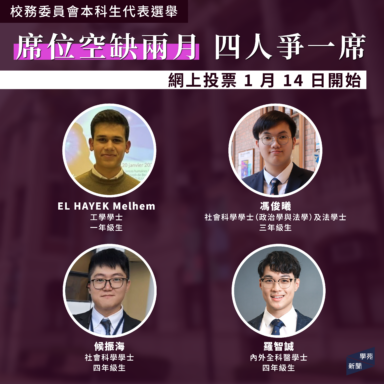
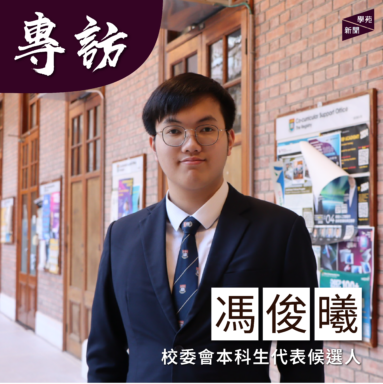
【學苑專訪】香港大學校務委員會本科生代表選舉投票將於 1 月 14 日上午 10 時至 1 月 16 日下午 5 時於線上舉行,四名候選人競逐一個席位。本報訪問候選人馮俊曦(Justin FUNG Chun Hei),了解其政綱及理念。本報曾嘗試聯絡候選人 EL HAYEK Melhem 及候振海(HAU Chun Hoi),未獲回覆;候選人羅智誠(Jason LAW Chi Shing)則因時間原因未能接受訪問。
候選人馮俊曦之專訪內容如下。
問:請簡單介紹自己,並簡述參選原因。
答:大家好,我是本屆校務委員會本科生代表選舉候選人,社會科學學士及法學士三年級生馮俊曦。我參選是因為留意到第一次提名期時無人參選,我認為學生需要有代表於校方的最高決策機關反映學生意見。同時,我亦看見近年校政氛圍較暗淡,因此希望挺身而出,帶動議事風氣,令大學生關心我們身處的校園及校方的決策。
問:你認為學生代表可於校委會中發揮的最大功用是甚麼?
答:我認為可分為兩方面。第一方面,校委會作出決策時會於會議上討論、投票,本科生代表的角色和責任是將學生意見帶入校委會。另外,在校委會會議之外,本科生代表是港大為數不多的學生民選代表,亦是身處最高權力機關內的代表,有很大的民意授權。因此,本科生代表也可以推動一些議程,或於校方推出政策時,統一收集同學意見及聯絡其他學生代表作出回應。
問:如果你當選後收集的學生意見與你本人立場不一致,你會如何處理?
答:由於我是學生選出來,理論上代表所有本科生,我會尊重及按照選民的意願行事。
問:請介紹你的政綱及你最希望在任期內完成的工作。
答:我的政綱主要分為三部分。第一是推動校政透明化,校政參與度低的其中一個原因是學生無從入手,不清楚大學發生的事,例如校委會現時只公開一些極為簡短的會議摘要、教務委員會及其他大學管治委員會的全部工作文件或會議紀錄皆不予公眾查閱,同學只能於學生代表徵詢意見或校方主動公佈後,才知道校方作出甚麼決策及其背後的考量。因此,現時環境極不透明。我希望上任後提升校政透明度,促請校委會、教委會及大學管治委會於會議後公開非機密的工作文件及會議記錄。
第二項政綱有關校園規劃。港大學生人數每年上升,但校園空間本就有限,導致餐廳、地鐵站電梯出現排隊問題,以至上下課期間大學街極度擠逼,反映現時校園承載力不足。而港大有嘗試透過不同工程改善情況,如以西高山住宿工程滿足日益上升的住宿需求,也有蒲飛路校園工程。但這些工程進度不斷延緩,一拖再拖。我上任後,希望跟進這些工程,確保工程能如時落成。
第三項政綱是重建學生會。另一個校政參與度低的原因,是2021年港大不再承認學生會地位後,學生再無代表全體學生的中央機構,向學校平等發聲。剩下的民選代表非常零散,權力割裂,無法統一地為同學發聲。故此,我希望能在任期內重建學生會。
問:你提及校政欠透明度,提倡校委會及其他管治機關公開決策記錄。翻查資料,2015年商台曾洩露校委會會議中有關副校長任命的錄音,校委會向高院申請禁制令,以維護保密原則。法院解釋保密作用包括保護大學的商業機密、 大學對法律意見保密性的特權、校委會會議中的言論自由等。你認為校委會打破保密原則是否切實可行?
答:我同意校委會會處理機密內容,為了大學利益,機密內容不應被泄露。因此,校委會的專業守則(Code of Practice)列明所有成員必須承諾會對會議內容保持絕對緘默,不能對外透露,且校委會成員都應以個人身份出任,作大學的信託人。然而,我認為校委會處理一些非機密的事情時,可作更詳細的會議摘要,或公佈刪減版(Redacted)的會議記錄,讓學生知道非機密內容。教委會及大學管治委員會的機密文件更少,如果校委會都公開會議摘要,我看不到教委會及大學管治委員會不公開其工作文件的原因。
問:你承諾當選後跟進校園工程進度,有何具體措拖?
答:我會和港大物業處及相關委員會定時溝通,了解進度,適當時向同學匯報。現時相關工程網站刊載的時間線較模糊,同學未必知道能否如期落成。針對較常規的工程延誤,只能令同學知悉,並向相關部門施加壓力,令他們知道其需要為延遲而負責。針對一些非常規、因突發事件的延誤,例如西高山及蒲飛路工程更換承辦商,我會跟進事情經過、更換承辦商的原因,並向同學交代。此項政綱的第二部份關於校園設施的維護,我會跟進前本科生代表鄧俊彥所作的努力,向校方詢問不同扶手電梯的維修情況,並敦促校方按早前承諾建立電子渠道,讓同學反映設施不足或損毀的情況。
問:你提倡建立新的中央學生團體,是否代表建立一個新的學生會?
答:這是我的個人政綱。學生有這樣的訴求,校方就應該回應。但新學生會應以何形態或模樣存在,甚至應否存在,都應透過大學與同學對話達成的共識決定。前提是校方不應回避此議題。
問:前幾任校委會本科生代表都希望重建學生會,但都未公開交代進度。你對重建學生會的進度有多少了解?
答:據我了解,前幾任本科生代表都有與校方商討,也有預備委員會準備文件討論新學生會的形態。可惜仍處於初步階段,校方亦未有積極回應。
問:如何評價現時校方與不同學生組織的關係?
答:我認為雙方關係不太良好。2021年港大不再承認學生會校內地位後,港大便成立了課外活動支援處,以管理學生組織。若學生組織需校方提供行政、場地支持,須向該處登記。2022至23年間,有不同學生組織僅因於校內活動使用「香港大學學生會」字眼,便被該處指違反規則,並指會令人誤會其於校內的角色,從而將學生組織於登記名冊除名,極度阻礙組織運行,亦是該處「有權用盡」的表現。
這種不信任持續至今。我知道在宏福苑大火期間,有學生代表於校內收集物資捐予災民。此事立意良善,亦符合港大教育宗旨,大學理應支持。然而,港大物業處卻以物資阻塞走廊為由,毫無預警地清走所有物資,更指「無責任解釋佢係邊個」。這些事件都反映大學與學生組織的不信任及不良關係。
問:早前,校方拒借場地予聯院會舉行宏福苑大火悼念活動,你對此有否評論?
答:校方僅指會按一貫指引行事,但沒有解釋實際拒借場原因,我不清楚校方是否因害怕觸動社會神經或輿論壓力而拒絕借場。我對此感到失望,宏福苑大火是對港人的巨大創傷,如學生想表達自己的感想或悼念亡者,我看不到任何拒絕的原因。港大校訓是明德格物,應樂見學生關心社會事務,與社會弱勢社群或受災者同行。因此我不明白,亦不理解為何校方拒絕借出場地。
問:你想對選民說的話。
答:以前學生會的會訓是「團結一致,獨立自主」,寄望學生能團結地向校方爭取權益,向社會表達大學生的意見,同時亦保有獨立的批判性思考,這對今時今日的港大學生仍有價值。希望大家可於有限空間中,好好珍惜自己的權利和自由,關心我們身處的校園到底發生甚麼事。
Interview to Candidate of Election of 1 Full-time Undergraduate Student to the Council Justin FUNG Chun Hei
Polling for the Election of 1 Full-time Undergraduate Student to the Council will be held online from 10:00 a.m. on 14th January to 5:00 p.m. on 16th January. Four candidates are contesting one seat. Undergrad interviewed candidate Mr. Justin FUNG Chun Hei, to understand his platform and beliefs. We attempted to contact candidates Mr. EL HAYEK Melhem and Mr. HAU Chun Hoi but received no response. Candidate Mr. Jason LAW Chi Shing was unable to accept the interview due to time constraints.
The interview with Mr. Justin FUNG Chun Hei is set out below.
Q: Please briefly introduce yourself and explain why you decided to stand for the election.
A: Hello everyone. I am Justin Fung Chun Hei, a third-year student pursuing a Bachelor of Social Sciences and a Bachelor of Laws, and a candidate in this year’s Election of 1 Full-time Undergraduate Student to the Council. I decided to run because I noticed that no one stood for the election during the first nomination period. I believe students need representation on the University’s highest decision-making body to convey student views. At the same time, I have observed a rather quiet atmosphere in university governance in recent years so I hope to revitalise discussion and encourage students to care about our campus and the University’s decisions.
Q: What do you think is the most important role a student representative can play in the Council?
A: There are two aspects. First, when the Council makes decisions through meeting and voting, the role and responsibility of the undergraduate representative is to bring student views into the Council. Second, outside Council meetings, the representative is one of the very few directly elected student representatives at HKU and sits within its highest governing body, thus having a strong democratic mandate. As such, the undergraduate representative can help initiate some agendas, and when the University introduces policies, it can coordinate the collection of student views and liaise with other student representatives to respond.
Q: If the views you collect from students differ from your personal opinion, how would you handle that?
A: As I am elected by students and, in principle, represent all undergraduates, I would respect and act in accordance with the wishes of the electors.
Q: Please introduce your platform and what you hope to achieve during your term.
A: My platform has three main parts. The first is to promote transparency in university governance. One reason for low student participation is that students do not know where to begin and do not know what is happening at the University. Currently, the Council only releases very brief meeting summaries. Full working papers and minutes of the Senate and other university committees are withheld from public access, so students only learn about University’s decisions and the underlying considerations when representatives solicit views or when the University chooses to make announcements. This creates a highly opaque environment. If elected, I hope to improve transparency by urging the Council, the Senate, and other university committees to release non-confidential working papers and meeting minutes after meetings.
The second part concerns campus planning. Student numbers increase every year, while campus space is limited. This has led to long queues at canteens and MTR station lifts, and severe congestion on University Street during class changeovers, showing that the campus is operating beyond its capacity. The University has tried to address this through various projects, such as the High West residential hall and Pokfield Campus. However, these projects have been repeatedly delayed. If elected, I will follow up on these projects to help ensure they are completed on schedule.
The third part is the reconstruction of the Students’ Union. Since the University ceased to recognise the Students’ Union in 2021, students no longer have a central body that represents all students and to speak to the University on an equal footing. The remaining student representatives are fragmented, with divided authority, making it difficult to speak in a unified way. I therefore hope to work towards rebuilding a Students’ Union during my term.
Q: You mentioned a lack of transparency and proposed greater disclosure from the Council and other governing bodies. In 2015, Commercial Radio Hong Kong leaked a recording of a Council meeting on a vice-presidential appointment, after which the Council sought an injunction to uphold confidentiality. The court explained that confidentiality protects commercial secrets, HKU’s privilege on legal advice, and freedom of speech within Council meetings. Do you think it is feasible for the Council to break the principle of confidentiality?
A: I agree that the Council handles confidential matters, and that such information should not be disclosed for University’s benefit. The Council’s Code of Practice requires all members to maintain strict confidentiality and to serve in their personal capacity as trustees of the University. However, for non-confidential matters, I believe the Council could provide more detailed meeting summaries or release redacted minutes so that students can understand what was discussed. The Senate and other university committees handle even fewer confidential matters. If the Council can release meeting summaries, I see no reason why these bodies should not make their working papers public.
Q: You have pledged to follow up on campus planning projects. What specific actions would you take?
A: I would maintain regular communication with the Estates Office and relevant committees to understand progress and report to students when appropriate. Current project timelines published on their respective websites are rather vague, and students may not know whether completion dates can be met. For ordinary delays, my role would be to inform students and put pressure on the relevant departments so they know they are accountable for delays and ensure timely completion. For non-ordinary delays caused by unexpected events, such as contractor changes at the High West and Pokfield projects which had led to one to two years delays, I would follow up on the reasons for these changes and explain them to students.
The second part concerns campus facilities maintenance. I would continue the work of the previous undergraduate representative, Mr. TANG Chun Yin, by asking the University about the maintenance status of various escalators and urging it to fulfil its earlier commitment to establish an electronic channel for students to report facility deficiencies or damage.
Q: You advocate establishing a new central student body. Does this mean creating a new Students’ Union?
A: This is my personal platform. If students have such demand, the University should respond. However, the form of how a new Students’ Union should take or whether it should exist at all, should be decided through communication between the University and students and by reaching a consensus. The key point is that the University should not avoid this discussion.
Q: Several previous undergraduate student representatives also hoped to rebuild the Students’ Union but did not publicly report on progress. How much do you know about the progress?
A: To my knowledge, previous representatives did discuss the matter with the University, and preparatory committees were formed to draft proposals on the structure of a new Students’ Union. Unfortunately, the process remains at an initial stage, and the University has not responded proactively.
Q: How would you assess the current relationship between the University and different student organisations?
A: I believe the relationship is not good. After HKU ceased to recognise the Students’ Union in 2021, it established the Co-curricular Support Office to manage student organisations. Organisations seeking administrative or venue support from the school must register with this office. Between 2022 and 2023, some organisations were deregistered simply because they used the term “The Hong Kong University Students’ Union” in campus activities, on the grounds that it might mislead others about their role inside the campus. This severely hindered their operations and reflected an “overly rigid use of authority”.
The lack of trust continues. During the Wang Fuk Court fire, some student representatives collected supplies on campus to donate to victims. The intention was positive and aligned with HKU’s educational mission, and the University should have supported it. Instead, the Estates Office removed all supplies without warning, citing corridor obstruction, and even stated that it had “no duty to explain who they are”. These incidents reflect poor relations and a lack of trust between the University and student organisations.
Q: Recently, the University refused to lend a venue to the Joint Faculty Societies for a memorial event for the Wang Fuk Court fire. Do you have any comments?
A: The University only said that it was following established guidelines, without explaining the specific reasons for refusal. I am not sure whether the school was concerned about social sensitivities or public pressure. I am disappointed. The Wang Fuk Court fire was a material trauma for Hong Kong society. If students wish to express their feelings or mourn the victims, I see no reason to refuse. HKU’s motto is Sapientia et Virtus, and the University should welcome students’ care for social issues and solidarity with vulnerable groups or disaster victims. I therefore do not understand why the lending was refused.
Q: Do you have any final words for the electors?
A: The former Students’ Union motto was “Unity with Independence” expressing the hope that students would stand together to safeguard their rights, voice their views in society, and maintain independent and critical thinking. These values remain relevant for HKU students today. I hope everyone will cherish their rights and freedoms within the limited space available, and care about what is happening on our campus.